Saturday, 7 December 2019

Naval Losses - October to December 1939

The U-boats are out and prowling, though two were taken out in the middle of October. One was got on the 8th off Dover, and two on the 13th, one taken out by destroyers south west of Ireland, the other by a mine in the English Channel. German pocket battleships are also at sea, raiders hunting for merchant ships. The Admiral Graff Spee has sank a merchant man off Brazil, and an Anglo-French task force was sent to hunt her down.

Radio Broadcast: Churchill Speaks from the Admiralty, 1st October

HMS Royal Oak
The 14th October saw the loss of the Royal Oak. It seems a U-Boat slipped into the moorings at Scappa Flow, and took out the battleship with ease. After the loss of the Courageous last month, this is a real blow. The mood in the pub has sunk - we all know the Navy is our strongest service, and it doesn't seem to be delivering what we expected from it. To add to things the roll call of merchants sunk by the Graff Spee in particular just keeps growing. The atmosphere in the White Hart was so gloomy I drank up and left.

News Reel: Royal Oak Sunk

Hitler talked peace on the 6th, and we and the French rejected that the same day, but the fighting still seems half-hearted, despite our loss of ships - it feels like things have stalled. A german bomber was shot down by the RAF on the 16th, and all men between 20 and 23 were registered for national service.

Then there was another U-boat attack - another battleship, HMS Nelson, hit by three torpedoes. None exploded, but there is no disguising that it was only luck. Late in November the German raiders made themselves felt again, the armed merchant HMS Rawalpindi caught by the German battle ships Sharnhorst and Gneisenau was sunk with ease.

Then on the 4th of December, in a bitter twist, HMS Nelson struck a mine. She survived, but is badly damaged and laid up for repairs. Just today, the 7th December, we have heard that the Graff Spee sank the merchant man Streonshalh. There was hardly anyone in the pub, and I didn't even bother stopping for a drink.

All the while the BEF is being built up, complete with royal visit. I only hope they do better than the Navy when the Germans really start. The Finns are not so lucky, though. The Russians invaded on the 30th November without even the pretence of a declaration of war. Feels like another Poland. Poor bloody sods.

News Reel: King with the BEF
News Reel: Finnish Minister on the invasion

Saturday, 12 October 2019

A month of war - September 1939

Polish Soldier 1939 - Public Domain via Wikipedia Commons
It has been a strange, uneasy time - at war, but what war? A pause for us all to think, sort ourselves out, with vicious fighting, but distant. Like a song heard from a long way away when you recognise the tune, but cannot make out the words. So far away that you can forget. I sat in the cinema last week, watched news reels, then a film - Rathbone, Hound of the Baskervilles. I'm ashamed to say it was good - so much so that the war slipped from my mind for over an hour. Then the news reel started again. The upbeat announcers, film of young, harried looking soldiers landing in France. Most of the news is grim, if not for us than for those in the firing line.

News Reel: BEF lands in France

Poland. Poor, poor Poland. Smashed by the Germans and the Russians. Conquered and portioned out in just weeks. That was how September was - a roll call of Polish defeats. Pszczyna, Tuchola, Krakow fallen by the 6th. The German Army was at the edge of Warsaw two days later. A siege, like something from the last war, but with aircraft this time too, bombing of a city like the Germans did in Spain. Whole parts of the Polish capital destroyed. Swift, terrifyingly decisive, but the Poles clung on, fighting like rats in the rubble. It was only on the 28th that Warsaw surrendered. With a Polish government in exile in Paris by the 30th, and the last resistance crumbling by the 5th of October, the Soviets rolling up town after town in their turn, you might well ask what we, the British and French, did?

News Reel: German Invasion of Poland

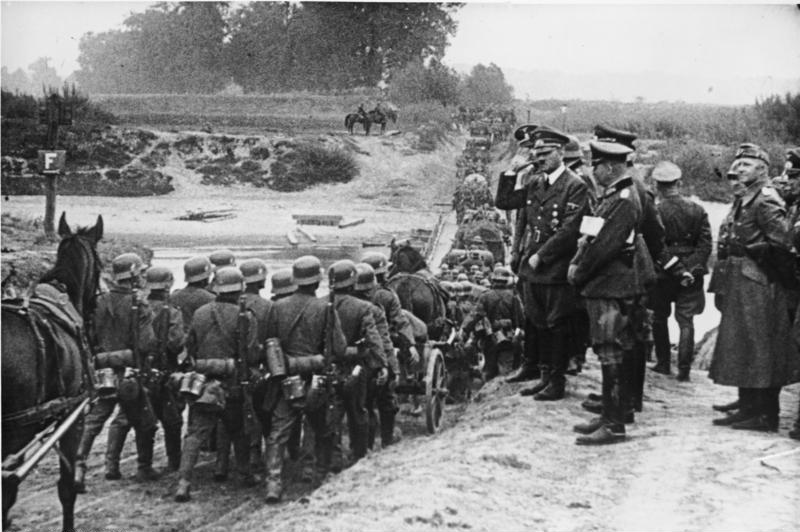
Hitler reviewing troops crossing into Poland.
Bundesarchiv, Bild 183-S55480 / CC-BY-SA 3.0 [CC BY-SA 3.0 de (https://creativecommons.org/licenses/by-sa/3.0/de/deed.en)]
We sat in fairyland while the country we had pledged to defend has simply been wiped off the map. the first week of our war was spent on paper work - the Dominions deciding, one by one to declare war in turn. Australia, on the same day as we ourselves declared war, then Newzealand, then Canada. In South Africa the government even proposed neutrality - though they were defeated and fell as a result. The new government are in for the fight now. Welcome, of course, but the cities of Poland were burning all the time. The RAF bombed a few German ports ineffectually, and showered the Ruhr with leaflets. The French at least prepared an attack into Germany's Saarland, but halted when Polish resistance seemed to be collapsing.

The SS Athenia was the first victim of the U-boats, back on the 3rd September. It was big news, but seems small, and a long time ago. On the 14th September there was much newspaper talk, speculation, confident assertion in the White Hart in Hingham - the Royal Navy is more than the equal of the Kriegsmarine - Ark Royal was attacked, again by a submarine, off Rockall. Their U-boats are clearly at sea, everywhere they can reach, but the torpedoes missed. All that casual optimism was blown away, just days later. The carrier Courageous went down on the 17th - off Ireland. A carrier sunk in practically home waters. A U-boat who's torpedoes found their mark this time. That relegated new fighting in China to a few column inches at the bottom of the newspaper front page. On the 20th the Navy got a U-boat - revenge of sorts I suppose. The talk is all of the navy getting into its stride, clearing the sea.

News Reel: Sinking of HMS Courageous

Ridiculous. We made commitments to Poland, we failed. The Far East is at war. At home our newspapers are counting the fighting in a plane or two here, a ship, or a submarine. All the while the British Army has been crossing to France to form another 'western front' like the last time.

It is over for Poland. The agony in China is years old. For us it hasn't even begun. We are at war, and we have to put our heart and soul into it, get it done. Yet everything we have done so far feels so naive and feeble - except to send the B.E.F. to die in France again.


Tuesday, 3 September 2019

It's War - Prime Minster's announcement and the King addresses the Empire

So, that is it. It's war when only this morning we were at peace. When the announcement was over my wife turned off the radio, my children went back out into the garden, and I just sat in silence. There isn't actually much else I can say - I just thought of the last war, my time in Macedonia, the grimness and inhumanity of the trenches, and I simply cannot believe that after that experience we are back here again. Somewhere, deep down, there is something of relief - few of us can really have believed that this would end up any other way, and now it is out in the open. It was half an hour before I could rise from my chair, and walked out to join the children in the garden.


Chamberlain's speech to the nation declaring war

The King to the Empire

Follow on twitter: https://twitter.com/chronomonology

Sunday, 1 September 2019

Follow on twitter:


https://twitter.com/chronomonology

September 1st 1939 - Poland Invaded. BBC Broadcast.

This evening, we heard that Germany invaded Poland early this morning. Reports are sketchy, some from German radio, but there has been bombing of many towns and cities including Warsaw, and Danzig has been 'decreed' part of the Reich. It's understood that both Britain and France have delivered ultimata to Germany, and we have restated our support of Poland. We're mobilising the armed services.

The news was broken by the B.B.C. We just sat around the radio afterwards, sun shining outside like the world isn't falling to pieces. The girls asked if there was going to be a war, and for the first time I knew I had to be honest. I told them that I don't know, but that if it does, we're prepared. If that's the truth or not, who knows?

Thursday, 22 August 2019

August '39 #WW2 #timetravel #Braemar #MassObs #DrumCastle #CraigievarCastle

Craigievar Castle - bus tour, August, 1939* 
On our long awaited trip up to Scotland. It was an experience in itself getting here - train from Norwich to London, then Edinburgh, Aberdeen, Ballater, and a bus onto Braemar. Our first day was spent back on a bus, but a tour of the castles round about - and it gave me a chance to use my new camera.

I thought it would be a chance to get away from the international situation, but of course radio and news papers get everywhere and the whole country is alive with the latest. It might almost be last September all over again, but there is a different feeling now. I ended up calling on the local doctors, a Dr Macallister*, and we talked for over an hour - I suspect I'm one of the few professional men he has seen in a while and he was keen to share his views. Both of us have the same sense: that with each crisis the feeling that we should just 'get it over with' grows, a sort of weary recognition that the continued hope for peace gets harder to endure than the worst actually happening. In fact, the doctor knows many in the village that are actively in favour of 'taking on Hitler', including an absurd man who has apparently taken it upon himself to ensure Braemar is ready for 'the hun', and is to be seen parading around in an old brodie helmet. All ill conceived bravado, mostly by people who for one reason or another haven't fought before, in a place so out of the way that it could not possibly be any sort of a target in any circumstances, but they are all being encouraged by the obvious national preparations.

What as late as July felt half hearted as far as the authorities were concerned, now suddenly seems all too real. There was the air defence practise earlier this month with, the press say, over 1500 aircraft. The King has reviewed the fleet, there was the national blackout test with half the country plunged into darkness, and it seems you can't see a stretch of open water at the moment without seeing the navy. As we crossed the Tay on our way up, there were a number of fast patrol boats stationed in the estuary - a well informed local told me that it was 'secret' but that everyone knew that submarines had been stationed here. Even Chamberlain adjourning the commons until October seems to have notched up the sense that things are coming to a head - giving the feel of 'a tough line' and the Prime Minister getting ready to take quick, decisive action. I swear I even heard a man on the train saying that when Hitler sees what we have to throw at him, 'even if the shooting starts, it'll all be over by Christmas'. Just the sound of those stupid, overconfident words sent me right back to the trenches in Macedonia, and all the idiocy that people talked before the last time, and I was almost physically sick.

Drum Castle - bus tour, August 1939*
Macallister and I met by chance in the pub a night later, and spent most of the night in war talk. We have the guarantee to Poland hovering over us, of course. We've been here before - Czechoslovakia - guarantee and subsequent total betrayal. Despite it all, neither he nor I could decide whether the humiliation of betraying Poland, or the prospect of honouring the guarantee, was worst. The best hope was that, insanely, the 'war war' voices have a point - that our obvious displays would warn Hitler off. There had been a flurry of optimism, or course, when the Anglo-French mission was sent to Moscow - a real feeling that we were building the pressure on Germany to compromise, even with constant news of border incidents, and a shooting at Danzig. All that was blown away by the announcement of the Nazi-Soviet non-aggression pact, and the withdrawal of the Anglo-French mission just days ago now, but it already seems like weeks.

After five pints each, we came to the startling conclusion that there's nothing we can do about it from a pub in Scotland, and gave it up as a bad job. I tried hard to put it out of my mind the next day, and my wife and my two girls went walking up the glen along the Dee, right into the Mar Estate - by permission procured via Macallister - and even got a snap or two.  The children's talk was all of their new school and their uniform fitting next week, as though the world was normal, and for a while it was wonderful to hear. Always, though, I kept coming back to the situation in Germany, and morbid thoughts of the last war, wondering where we might be in even just a month's time let alone what we might be doing next summer. It was walking in the glen that I realised I myself may well have joined the group that is finding the waiting and hoping too much. Despite knowing what I went through last time, despite looking at the faces of the young men on the train up here, and walking around Braemar and knowing that it is they who will have to fight, I have started just to want to know what it is we have to do, and get on with it.

As I said, radio gets everywhere - it connects you where ever you are instantly to what is happening. The cottage we have taken has an old, but surprisingly good set, and a weekly delivery of the Radio Times and despite my need to get away from things the temptation to turn it on was too much. I was able to follow the 3rd Test against the West Indies from the Oval (a draw, if you're interested, but which means we won the series), caught the last episode of 39 Steps which I have been following, and would have been sad to have missed, but on Tuesday I was caught out, and confronted with announcements from the Government concerning public services in the event of war, and a programme on lessons learnt from air raids in Spain. I spent the rest of the evening in a foul mood.

My holiday reading won't have helped much - the publishers Penguin have been rushing out special editions, and I have ordered the most sensible looking ones from my book sellers, Hollyman and Treacher. Just before we set out one arrived - I still get a flutter of excitement at the sight of those neat little brown paper parcels, even if the reading the promise is now grimes than it used to be. This one is an account from the Mass Observation movement of public opinion during the Czech crisis, but more interestingly, also an analysis of how poor our ability as a nation is to 'gauge the public mood'. Newspapers talk as though the nation talks with one voice, as though there is a singular 'will of the people', but this, of course, is just the opinion of leader writers and editors, amplified by a few like minded others they have talked to. Once you notice it, it is a feature of every news publication, and even B.B.C. broadcasts. People read a newspaper that echos their view, and they in turn echo the view of the newspaper they read. Similar people read similar newspapers, and so suddenly it seems, for example, to every reader of The Daily Express, that all readers of The Daily Express are united and that 'the nation has spoken'. We are, in effect, according to the Mass Observation people, trapped in little tribes, mutually reinforcing the opinions of those that we know, and those that are 'like us'.

It is not scientific, I know, but I have tried to talk to as wide a cross section of people here as I can, and I find two simple and obvious things: opinion on the whole affair is very similar to last September, but people's views are harder and more entrenched now. The second is that I am happy to agree with Macallisater because he and I are alike, and because, simply put, he has the good sense to agree with me.

*This blog aims to incorporate as much of my real life in 2019 into Fincham'39's experiences as possible. I did indeed find myself in a GP's surgery for over an hour in Braemar at this time, and had a very stimulating conversation about modern British politics. He was not called Macallister, but I hope he would recognise the sentiments of our conversation translated into the context of August 1939. We also visited Dundee, looked out over the Tay, and did walk right up into the Lynn of Dee across the Mar Estate. I cannot deny that reading 'Britain by Mass-Observation' in the calm of the Highlands whilst overshadowed by BREXIT struck a worrying chord. All photos taken August 2019.

Specific Sources:
August 1939 time line
Radio Times Issue 829, dated August 18th 1939
3rd Test against the West Indies - full score card for August 1939
Dundee Submarine Base HMS Ambrose

Thursday, 11 July 2019

A long summer - state of play in July 1939 #WW2 #timetravel

Our DFP - 'Damn Fool Purchase'. 
So, it's mid July 1939. If you need to know why, read this before continuing. If you don't know who is writing, then you need to read this.

Objectively speaking, the world is in a mess. A distant war has been going on between the Chinese and the Japanese since 1931. In Europe, we are in the aftermath of the Spanish Civil War, which for informed citizens highlighted the weakness of western democracies against the Facists. Strangely, before that the Italians were the senior partners, now it's the Germans, and of course with them both is the government of Franco.

Hitler has made all the running in Europe. He annexed the Rhineland back in '36, and whilst the avoidance of war over Sudetenland last year was a relief, it was another bloodless victory for the Nazi leadership and it didn't feel to anyone like the tension eased in any meaningful way.  Many still hoped that German pressure could be managed, a small concession here, a small concession there, but the concessions no longer seem all that small. A voice getting stronger each day is that we have to take a stand at some point, but what that stand may be, everyone is afraid to really think about. The Germans annexed the rest of Czechoslovakia in March, just three months ago, and the tension is running high again. That is particularly so as Germany now has its sights on Poland - the 'sticking point' this time being Danzig. The Germans want the enclave of East Prussia connected to their homeland, and Danzig is in the way. It seems to me incredible that giving more is going to secure lasting peace, but for some that one city given over to Hitler seems a small price to pay to avoid a war. In reality, most people don't want to think or talk about it.

The truth is, we are all piecing together odd scraps of news from papers and radio broadcasts. The BBC gives us succinct bulletins, but obviously we hear little of discussions behind closed doors. However, the fact that we know so little suggests that the high level contacts between our government, the Italians, the French and Russians mean that something major is going on - a drive to prevent another war. Against that background The Red Army have been sucked into the Japanese invasion of North China, and clashes have occurred on the Mongolian border. We've had out the family atlas trying to work out exactly where the fighting is, largely wondering if it offers real hope that Stalin will come in on our side should the worst come, and that the Russians will give the Germans pause for thought.

Closer to home, there is the occasional flurry of what might be called war preparation, soldiers a little more visible, a military surveying party on the edge of Norwich last weekend, a small naval vessel out in the wash the last time we were at the beach hut. It seems half hearted, though, to the casual observer and despite everything, it feels like officialdom doesn't really think the latest crisis will be any more serious than the last over Czechoslovakia. Ultimately, days carry on as normal: we have a family trip to the Lakedistrict and on to Scotland in prospect for August. Our twin daughters start in a new school in September and there is great excitement at the thought of a trip to the school outfitters in Norwich. We dined at the Ivy for my wife's birthday. Crops are ripening in the fields and it looks like we'll have a good haul of apples from the garden this year. A strong sense of normality pervades everything, despite the voices on the radio.

On a down note the paint on one side of the beach hut, freshly re-done at Easter, has peeled already. I think I forgot to prepare the surface first. Who ever thought it was a good idea to try and maintain a shed on the coast? The hut, however, has no radio reception, is calm and slow, and the only place where I can really relax, cut off form the world. Except for seeing that navy vessel out in the wash, small though it was. I sat in a deckchair drinking tea and watching it steam into the distance for almost an hour.

Saturday, 6 July 2019

On the importance of Chromonology and Chromonaughts #WW2 #timetravel

Chrononaught
All you need to know about the WW2 Chronomonological project.
Meet the Chrononaught
Sources

Chronomonology:
invented noun
1: The science of experiencing phenomena through time. An approach that concentrates on the study of consciousness and directly experienced events as they play out in real time.
2: A labour intensive form of pseudo time travel.

Chrononaught:
another inverted noun
One engaged in the practice of of Chronomonology


In the instance of 'Chronomonolgy: a time of war' the charting of the events of World War 2, seen through the eyes of a semi-fictional character consistent with the time to give a perspective. To experience the war in real time will take from 2019 to 2025, and will start now.