Wednesday, 8 April 2020

Looking to Spring - 1940

February and March were almost as quite as January - unless you we Finnish. The Soviets finally breached the Mannerheim Line during the Battle of Summa and then attacked the city of Viipuri. By the 10th of March Viipuri was lost, and by the 12th the Finns had conceded 16,000 square miles in exchange of peace. Britain and France would have intervened, but were blocked by Norway and Sweden from doing so.

The Royal Navy intercepted a German ship, the Altmark in Norwegian waters, releasing hundreds of British prisoners - the Norwegians protested, as they are Neutral, and the Germans described the action as piracy. The navy also stopped an Italian convoy laden with coal bought from Germany.

The odd U boat sunk, a liner sent to the bottom of the English Channel. They mounted an air-raid on our Home Fleet base at Scapa Flow, we raided their seaplane bases at Sylt and Hornum.The first German aircraft of the war was shot down over Whitby - a Heinkel-111. This was particularly bitter - we travel to Whitby every year for a family holiday, and have done since the girls were small. Perhaps the first real impact on us as a family was the realisation that a holiday booked with the land lady when we left last year is just not on under the current circumstances.

Whitby holiday snap - just last year, but it seems a world away.

Just posturing, until Churchill's speech on Neutral States. He said that they could not be blamed, but by balking at war and by bowing the German demands for material, they would extend the war and that it not in the interests of Britain or the 'common good' for their strength to be added to that of the enemy. I met a friend of mine for lunch in Norwich, a man I used to work with, and we talked about almost nothing but that speech. It can mean almost nothing but that we are prepared to act against neutral countries.

As we left, I saw the woman who ran the tea shop staring at us, and looking meaningfully at a poster she had just pinned to the wall. 'Careless talk costs lives' it said. As we walked away, I was in two minds. Did she have a point, or was she just an interfering busy body enjoying a moment of supposed moral superiority? Probably the later, but I couldn't shake myself of the uneasy feeling that she might have been right. Strange how these situations bring out other the best and worst in people, and how hard it can be to tell them apart.

Then, on the 4th of April, came a fantastic speech by the Prime Minister that lifted my spirits. Hitler has 'missed the bus'. We brought enough time to catch up in terms of war material and the Empire is mobilising fast. But given Churchill's speech, this can only mean the the behind the scenes the neutrals are not so neutral and that Europe will stand together. Feels like spring, and I've promised the family that we'll make Whitby next year.

Coverage of the speech.

Newspaper reaction to 'Hitler has missed the bus'.


Tuesday, 28 January 2020

The strange dead January of 1940

The start of the year has been a strange. The Soviets have pushed at the Finns again, and again been defeated, loosing multiple divisions. On the 28th, numbers of Soviet troops were forced to surrender around Lake Ladoga. A German plane containing plans for the invasion of the low countries crashed in Belgium, which has roused those smaller, vulnerable nations, to our benefit I suspect. There have been ships lost, but U-boats sunk in return. The war has stalled.

Convalescence
By far the worst has been the weather. On the 17th of January the temperature fell and the Thames has actually frozen - for the first time since 1888, according to the paper. Lucky we have a full coal bunker, through we've been sparring with it, only heating the living room. A tree has come down in the garden, which I will split up and season, so at least we should be alright next year.

Then there is the vexed subject of teeth. I went to the dentist just before Christmas with a wobbly tooth, and have ended up with two extractions, and some more painful procedures all of which have left me weak, more than a little dizzy, and almost disinterested in the news. We took advantage of a chance to get up to the beach hut, but it was so cold we could only manage a couple of hours. There is barbed wire along parts of the beech now at Hunstanton, which wasn't there before, though I find it hard to image why the Germans would attack 'Time and Tide'.


December 1939

Finland has achieved something little short of a miracle. Details are sketchy, but the Soviets seem to have underestimated the harsh winter conditions, and despite all odds the Finns have held them. By the 5th December the Soviets had reached the Mannerheim Line - prepared defences using all of natures advantages, After a few weeks hard fighting, the Soviets halted, their offensive finally halted at Kelja and Taipale on the 27th. The map of Finland that I ordered from Stamfords arrived for me to point out to the family where the fighting had just ended.

I don't usually sleep well, and in the early hours of the 18th a distant drone woke me. I wasn't sure what it was, but it came from the west. It was only in the newspapers over the next few days that I realised must have been RAF bombers taking off from the airbase at Mildenhall, down across the Suffolk border. They raided a German port that night, but the press weren't really clear with what result.

Graf Spee showing battle damage whilst in Montevideo - public domain
The biggest event of the month, though, has to be the Graf Spee. Cornered on the 13th of December by the cruisers Ajax, Exeter and Achillies a great naval engagement off the South American coast. The Exeter, it seems, was very badly damaged, but the Graf Spee retreated into Montevideo. Uruguay is neutral of course, and the German battleship was forced to leave on the 17th, and the German captain, Langsdorff, scuttled his ship in the River Plate.

After a steady stream of ships lost, this felt like a message to the world, and faith in the navy has certainly been restored amongst my drinking friends in the White Hart.

News Reel: Graf Spee scuttled!

All through the month help has started to arrive. An Australian fighter squadron and the first Canadian troops have arrived. In contrast, the Americans have underlined their neutrality, and even complained about us seizing German goods on neutral shipping.

News Reel: President Roosevelt stresses American Neutrality

On the whole, though, we enter 1940 in good spirits, except that rationing, neusacnce value until now, will bit a little more in the new year and is extended to butter, bacon, ham and sugar. Never really that fond of bacon anyway.

Saturday, 7 December 2019

Naval Losses - October to December 1939

The U-boats are out and prowling, though two were taken out in the middle of October. One was got on the 8th off Dover, and two on the 13th, one taken out by destroyers south west of Ireland, the other by a mine in the English Channel. German pocket battleships are also at sea, raiders hunting for merchant ships. The Admiral Graff Spee has sank a merchant man off Brazil, and an Anglo-French task force was sent to hunt her down.

Radio Broadcast: Churchill Speaks from the Admiralty, 1st October

HMS Royal Oak
The 14th October saw the loss of the Royal Oak. It seems a U-Boat slipped into the moorings at Scappa Flow, and took out the battleship with ease. After the loss of the Courageous last month, this is a real blow. The mood in the pub has sunk - we all know the Navy is our strongest service, and it doesn't seem to be delivering what we expected from it. To add to things the roll call of merchants sunk by the Graff Spee in particular just keeps growing. The atmosphere in the White Hart was so gloomy I drank up and left.

News Reel: Royal Oak Sunk

Hitler talked peace on the 6th, and we and the French rejected that the same day, but the fighting still seems half-hearted, despite our loss of ships - it feels like things have stalled. A german bomber was shot down by the RAF on the 16th, and all men between 20 and 23 were registered for national service.

Then there was another U-boat attack - another battleship, HMS Nelson, hit by three torpedoes. None exploded, but there is no disguising that it was only luck. Late in November the German raiders made themselves felt again, the armed merchant HMS Rawalpindi caught by the German battle ships Sharnhorst and Gneisenau was sunk with ease.

Then on the 4th of December, in a bitter twist, HMS Nelson struck a mine. She survived, but is badly damaged and laid up for repairs. Just today, the 7th December, we have heard that the Graff Spee sank the merchant man Streonshalh. There was hardly anyone in the pub, and I didn't even bother stopping for a drink.

All the while the BEF is being built up, complete with royal visit. I only hope they do better than the Navy when the Germans really start. The Finns are not so lucky, though. The Russians invaded on the 30th November without even the pretence of a declaration of war. Feels like another Poland. Poor bloody sods.

News Reel: King with the BEF
News Reel: Finnish Minister on the invasion

Saturday, 12 October 2019

A month of war - September 1939

Polish Soldier 1939 - Public Domain via Wikipedia Commons
It has been a strange, uneasy time - at war, but what war? A pause for us all to think, sort ourselves out, with vicious fighting, but distant. Like a song heard from a long way away when you recognise the tune, but cannot make out the words. So far away that you can forget. I sat in the cinema last week, watched news reels, then a film - Rathbone, Hound of the Baskervilles. I'm ashamed to say it was good - so much so that the war slipped from my mind for over an hour. Then the news reel started again. The upbeat announcers, film of young, harried looking soldiers landing in France. Most of the news is grim, if not for us than for those in the firing line.

News Reel: BEF lands in France

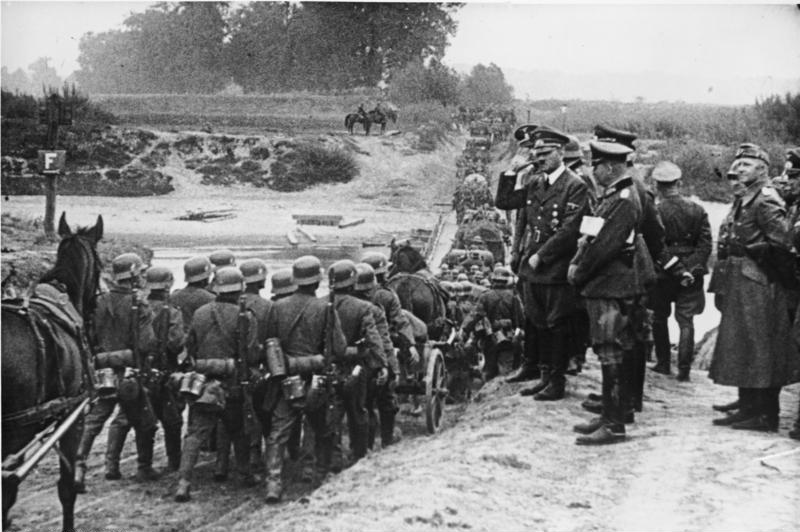
Poland. Poor, poor Poland. Smashed by the Germans and the Russians. Conquered and portioned out in just weeks. That was how September was - a roll call of Polish defeats. Pszczyna, Tuchola, Krakow fallen by the 6th. The German Army was at the edge of Warsaw two days later. A siege, like something from the last war, but with aircraft this time too, bombing of a city like the Germans did in Spain. Whole parts of the Polish capital destroyed. Swift, terrifyingly decisive, but the Poles clung on, fighting like rats in the rubble. It was only on the 28th that Warsaw surrendered. With a Polish government in exile in Paris by the 30th, and the last resistance crumbling by the 5th of October, the Soviets rolling up town after town in their turn, you might well ask what we, the British and French, did?

News Reel: German Invasion of Poland

Hitler reviewing troops crossing into Poland.
Bundesarchiv, Bild 183-S55480 / CC-BY-SA 3.0 [CC BY-SA 3.0 de (https://creativecommons.org/licenses/by-sa/3.0/de/deed.en)]
We sat in fairyland while the country we had pledged to defend has simply been wiped off the map. the first week of our war was spent on paper work - the Dominions deciding, one by one to declare war in turn. Australia, on the same day as we ourselves declared war, then Newzealand, then Canada. In South Africa the government even proposed neutrality - though they were defeated and fell as a result. The new government are in for the fight now. Welcome, of course, but the cities of Poland were burning all the time. The RAF bombed a few German ports ineffectually, and showered the Ruhr with leaflets. The French at least prepared an attack into Germany's Saarland, but halted when Polish resistance seemed to be collapsing.

The SS Athenia was the first victim of the U-boats, back on the 3rd September. It was big news, but seems small, and a long time ago. On the 14th September there was much newspaper talk, speculation, confident assertion in the White Hart in Hingham - the Royal Navy is more than the equal of the Kriegsmarine - Ark Royal was attacked, again by a submarine, off Rockall. Their U-boats are clearly at sea, everywhere they can reach, but the torpedoes missed. All that casual optimism was blown away, just days later. The carrier Courageous went down on the 17th - off Ireland. A carrier sunk in practically home waters. A U-boat who's torpedoes found their mark this time. That relegated new fighting in China to a few column inches at the bottom of the newspaper front page. On the 20th the Navy got a U-boat - revenge of sorts I suppose. The talk is all of the navy getting into its stride, clearing the sea.

News Reel: Sinking of HMS Courageous

Ridiculous. We made commitments to Poland, we failed. The Far East is at war. At home our newspapers are counting the fighting in a plane or two here, a ship, or a submarine. All the while the British Army has been crossing to France to form another 'western front' like the last time.

It is over for Poland. The agony in China is years old. For us it hasn't even begun. We are at war, and we have to put our heart and soul into it, get it done. Yet everything we have done so far feels so naive and feeble - except to send the B.E.F. to die in France again.


Tuesday, 3 September 2019

It's War - Prime Minster's announcement and the King addresses the Empire

So, that is it. It's war when only this morning we were at peace. When the announcement was over my wife turned off the radio, my children went back out into the garden, and I just sat in silence. There isn't actually much else I can say - I just thought of the last war, my time in Macedonia, the grimness and inhumanity of the trenches, and I simply cannot believe that after that experience we are back here again. Somewhere, deep down, there is something of relief - few of us can really have believed that this would end up any other way, and now it is out in the open. It was half an hour before I could rise from my chair, and walked out to join the children in the garden.


Chamberlain's speech to the nation declaring war

The King to the Empire

Follow on twitter: https://twitter.com/chronomonology